fortunesweave.online Logofortunesweave.online

The loop, and why it is measured in hours

Fortune's Weave replaces the classic chapter treadmill with a preparation loop. Each Main Battle is announced ahead of time with a stat card of information and recommendations, and the same card states how many Turns you have before you have to start fighting. Because one Turn is six in-game hours, the deadline is a real budget rather than a countdown: a week of Free Time is a fixed number of six-hour blocks to spend on meals, training, shopping and support conversations.

Every system below feeds that budget in some way. Shopping and training spend Turns to raise a roster; meals and rests spend them to raise supports; dungeons spend a different kind of currency, which is Renown, and pay back in chests. The one thing the loop will not let you do is convert Turns into everything at once, which is the actual difficulty of the game.

Verified Video Intel · Audio Transcript

Combat Loop & Exploration Mechanics Field Guide

Coverage by PhillyBeatzU · Verified English Captions
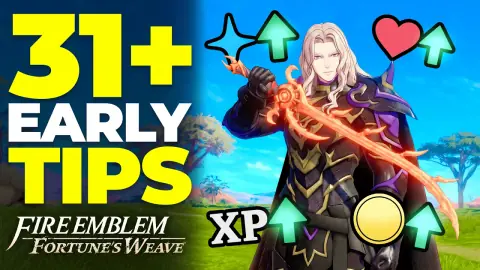
31+ EARLY Game Tips You Must Know (Fire Emblem Fortune's Weave)
01 · Time Budget

Quarter-Day Turn Economy

Time is strictly partitioned: 4 turns equal 1 full in-game day (each turn represents a 6-hour segment). Moving across the world map consumes turns, requiring careful route planning to avoid missing weekly resets in Dagsion.

02 · Holy Day Cycles

Deity Devotion Multipliers

Temple services accumulate devotion that unlocks battle-altering blessings. Consult the in-game calendar for designated Holy Days, which multiply favor gains when praying to specific patrons.

03 · Zero-Turn Meals

Inn Dining & Sunday Discounts

Sharing meals at the inn raises bond levels without consuming turn units—costing only gold. Dining on Sundays grants a 50% discount across all dishes, making weekend town visits ideal for economical support grinding.

Every core system in one place

The 6 systems recorded here are the ones that change how a week is planned rather than the ones that only appear in battle.

Free TimeBetween battles

Preparation time before a Main Battle, measured in Turns.

  • One Turn equals six in-game hours, and the deadline before the next chapter battle is expressed as a number of Turns.
  • Exploring Dagsion covers the Shopping Arcade for weapons and items, weekly access to a training facility, and spectating other teams in the Heroic Games.
  • Inns are where meals are shared, units rest, time is passed, and support conversations happen; an auto mode can run the chores to build levels and gather resources.

Main BattlesBetween battles

The chapter-equivalent stages of the Heroic Games.

  • A stat card previews each Main Battle with information and recommendations for preparing units.
  • The same card states the Turn limit allowed before the battle has to begin.
  • Main Battles are staged in the Grand Arena, and the layouts are drawn from historical battles in Dagda's history.

Tactical combatCombat

The primary battle system, inherited from the series.

  • Weapon types replace the weapon triangle with individual baseline mechanics.
  • Combat Arts are available to units that carry the weapon which unlocks them.

ClashCombat

The secondary combat system used in dungeons and in specific story events.

  • Closer to a party-based turn-based RPG than a grid battle, used inside dungeons.
  • The party shares one collective HP total; reducing it to zero forces an evacuation from the dungeon.
  • The command menu covers Attack, Combat Arts, and a Link command that pairs two characters for an action such as attacking or healing.
  • Linking is paid for with a separate resource, Link Points.
  • Combat can be skipped and resolved automatically.

Blaze ArtsCombat

Character-specific Combat Arts paid for with HP rather than weapon durability.

  • Nine characters have Blaze Arts, and each Art consumes a portion of the user's HP that varies per Art.
  • Performing Arts fills a Blaze Meter: half full triggers Overblaze, which boosts stats and unlocks certain Arts.
  • A completely full meter triggers a Burst, which empties the gauge but halves the user's maximum HP for the remainder of the battle.
  • The three types are Celestial Wells (Mediators), Underworld (cursed object users) and Automaton (Automations).
  • Celestial Wells fill the gauge even with ordinary attacks and are reduced by cursed weapons; Underworld Arts come from the character's cursed object and are fuelled by them.

Fortuna's BlessingRewind

The turn-rewinding mechanic, granted through Divine Sand.

  • Fortuna gives Eshmel a pouch of Divine Sand, which turns back time; the supply is limited in both quantity and how far it reaches.
  • Each Flame Lord receives a pouch as part of the plan to change their fates, and the handovers happen at different points in the chronology.
  • Leda receives hers in 1444 during the Cydonia Massacre as she retrieves Obsidian; Cai receives his on 01/24/1449 at a shrine to Fortuna after a pure white Ornius drags him there; Dietrich receives his shortly after arriving in Dagda and allying with Fabio; Theodora receives hers shortly after learning of the attempt to speed up Dyan's coronation.

Blaze Arts: 9 characters, 25 recorded Arts

Blaze Arts are the sharpest expression of the systems above because they are paid for out of the character rather than out of an inventory. There is no weapon durability cost: each Art consumes a portion of the user's HP, and the portion differs from Art to Art. Using Arts fills a Blaze Meter, and the meter has two thresholds that matter. Half full grants Overblaze, which raises stats and unlocks certain Arts. Completely full triggers a Burst, which empties the gauge but halves that character's maximum HP for the remainder of the battle.

That structure creates the real decision. Overblaze is strong enough to want on purpose, and a Burst is punishing enough to avoid by accident, so tracking your own meter is a skill the game tests constantly. The three types matter here too: Celestial Wells fill the gauge even with ordinary attacks, Underworld Arts come from a character's cursed object and are fuelled by it, and Automaton Arts do not refill from cursed weapons at all. No Automaton Arts are recorded in the sources checked yet, so that type is listed without a table.

Who has Blaze Arts

CharacterBlaze typePower sourceRecorded Arts
EshmelCelestial WellsLeader's Heart Core1
AnatoliaCelestial WellsSeven-Star Engine5
CaiUnderworldRed Jewel3
DietrichUnderworldInk-Black Wen3
TheodoraUnderworldMahadu's Right Arm2
LedaUnderworldObsidian5
TalimunUnderworldDhaba's Compass3
BertrandUnderworldBloodaxe Curse3
MariaUnderworldMoonstoneNames not recorded yet

Celestial Wells6 recorded

ArtCharacterEffect
Purifying FlashEshmelPierces foes with a spear of holy light. Effective against undead.
Dragon Strike IAnatoliaUnleashes force refined within the body as an area attack. Can destroy obstacles.
Dragon Strike IIAnatoliaUnleashes force refined within the body as an area attack. Can destroy obstacles.
Dragon Strike IIIAnatoliaUnleashes force refined within the body as an area attack. Can destroy obstacles.
Shining Dragon StrikeAnatoliaArea attacks that damage all foes in range and destroy obstacles; the affected area grows with each tier.
Dragon RotationAnatoliaUnleashes a spiral of energy. Can destroy obstacles.

Underworld19 recorded

ArtCharacterEffect
Underworld BurstCaiFires a blast from the gem in his palm for long-range area damage. During Overblaze it leaves Underworld Flames that damage enemies standing on them.
BlackfireCaiFires a cone of dark fire. During Overblaze it leaves Underworld Flames that damage enemies standing on them.
Underworld InfernoCaiAvailable only during Overblaze. Fires a blast of dark fire along a straight line with a circular area at the end, leaving Underworld Flames behind.
Moving ShadowDietrichWarp up to three spaces after moving, then attack.
Stifling ShadowDietrichWarp up to three spaces after moving, immobilising enemies within two spaces.
Umbra CalamityDietrichEffect not recorded in the source checked.
Earthen ThrowTheodoraPitches a chunk of rock straight at a foe.
Earthen HurlTheodoraLobs a boulder ripped from the ground at an area of enemies.
Song of BeastsLedaSummons a Demonic Beast. Once per map.
Song of MadnessLedaEffect not recorded in the source checked.
Song of PassionLedaGrants Strength +4 and Magic +4 to all allies in range for one turn; upgradable for larger boosts.
Song of IcewaterLedaGrants Defence +4 and Resistance +4 to all allies in range for one turn; upgradable for larger boosts.
Song of AbjuringLedaGrants effectiveness against undead to all allies in range for one turn.
Collapsing CurseTalimunInflicts Numb for one combat or one turn, halving Hit. The area grows during Overblaze.
Slowing CurseTalimunInflicts Slow for one combat or one turn, halving attack speed. The area grows during Overblaze.
Unlucky CurseTalimunInflicts Jinx for one combat or one turn, halving Luck. The area grows during Overblaze.
Ruler's AwakeningBertrandGrants Hit +50 until the next phase; the unit can attack after using it.
Flash AwakeningBertrandGrants Protection +10 until the unit's next phase; the unit can attack after using it.
Reason AwakeningBertrandGrants Resistance +10 until the unit's next phase; the unit can attack after using it.

Two Arts are listed without an effect because the source has not recorded what they do, and one row on the character table carries an attribution the source itself contradicts. Both are left exactly as written instead of being tidied into something tidy but wrong.

Frequently asked questions

How long is one Turn of Free Time?
Six in-game hours. The deadline before the next Main Battle is given as a number of Turns, which is why planning a week is really planning how many six-hour blocks you can spend before the next fight.
What is the difference between tactical combat and Clash?
Tactical combat is the grid battle system the series is known for. Clash is the dungeon system, closer to a party-based turn-based RPG: the party shares one HP pool, losing it forces an evacuation, and commands cover Attack, Combat Arts and a Link action that costs Link Points.
How do Blaze Arts actually work?
They are character-specific Combat Arts paid for with HP instead of weapon durability. Using them fills a Blaze Meter: half full grants Overblaze, which raises stats and opens up certain Arts, and a completely full meter triggers a Burst that cuts maximum HP in half for the rest of the battle.
How do you unlock Fortuna's Blessing?
Through Divine Sand. Fortuna gives Eshmel a pouch, and each Flame Lord receives one at a different point in the chronology, so the rewinding ability arrives with the character rather than with the chapter.

Blaze Arts are tied to cursed objects, and the equipment page records which objects belong to which characters and where each one comes from.