
Deities of Dagda
The twelve named gods behind the place names, the blessings and the antagonist, and which six of them actually pay out in gameplay.
Twelve names, and they are everywhere
Dagda names 12 deities, and the reason to learn them is that they are load-bearing: the continent, the pantheon, the imperial capital of Dagsion and a shelf of shrines and temples all borrow these words. A name encountered in a quest title is usually a god rather than a place.
Dagda names twelve deities. Six of them appear again in the shop list at the Shrine of Causality as blessings whose discounts can be bought with Karma Shards.
Balor, the god of the underworld, is the central antagonist of the game rather than a background figure.
The continent, the pantheon and the imperial capital of Dagsion all take their names from this group, which is why the same handful of words turns up across place names and blessings alike.
Aurora is both a deity here and the name of a blessing. Cai~s mother is also recorded as Aurora, an Aubin bearer, and no source states whether the three are meant to be read together.
The full pantheon
Only 5 of the 12 carry a domain in the record. The rest are listed by name with no role attached, which is stated here rather than smoothed over with a plausible-sounding invention.
| Deity | Domain | What else is recorded |
|---|---|---|
| Sothis | The Progenitor | The founding deity of the pantheon and the name the series uses for the origin of crests. |
| Fortuna | Goddess of Fate | The goddess the game is named after. Fortuna's Temple appears on the map as a quest location. |
| Aurora(blessing sold) | Not recorded | Recorded as the daughter of Solel and Yu Phas. Shares a name with one of the six blessings sold at the Shrine of Causality. |
| Mars(blessing sold) | God of military prowess | One of the six blessings whose discount is sold at the Shrine of Causality. |
| Kalla(blessing sold) | Goddess of hunting and the arts | One of the six blessings whose discount is sold at the Shrine of Causality. |
| Balor | God of the Underworld | The central antagonist of this game. |
| Smyrnos(blessing sold) | Not recorded | Listed among the other gods. Smyrnos also names the shrine where Combat Arts are strengthened. |
| Jurah(blessing sold) | Not recorded | Listed among the other gods, with a blessing discount sold at the Shrine of Causality. |
| Credna(blessing sold) | Not recorded | Listed among the other gods, with a blessing discount sold at the Shrine of Causality. |
| Yu Phas | Not recorded | Recorded as one of Aurora's parents. |
| Solel | Not recorded | Recorded as one of Aurora's parents. |
| Dagda | Not recorded | The namesake of the continent and the pantheon. |
The six that pay out
The other half of the pantheon matters because it is purchasable: Aurora, Mars, Kalla, Smyrnos, Jurah, Credna each have a blessing whose discount sits in the Shrine of Causality shop, bought with Karma Shards earned from Notable Deeds. Buying them is a permanent, account-wide upgrade rather than a route choice.
Smyrnos is the one to watch, because the name does double duty: the shrine where Combat Arts are strengthened carries it, and the crown of Smyrnos is the Dagdan name of Macuil's Diadem. That tie between a god, a shrine and a crest is the clearest single clue to how religion is wired into the systems rather than painted on top of them.
Balor gets a location too, in the Temple of Balor, which is worth knowing before Part III: the antagonist's name on a dungeon usually means something is waiting there.
Temple Row and What Each God Pays Out
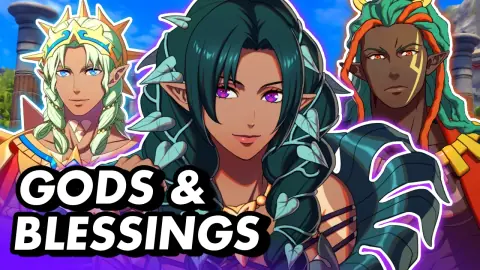
The table above lists the pantheon by name and domain. This captioned gods-and-blessings guide supplies what the tables could not: where each god is housed in the capital, which ones you can actually serve, and the shape of the battlefield benefit each one grants. It is recorded here as video-reported detail rather than as settled fact: it rests on one creator's read of the game, so it is written below as his account, and the numeric tiers he quotes are deliberately left out because captions are not a reliable source for values.
Nine temples, six you can serve
Temple Row is a two-tier street. The upper level holds the temples of Jurah, Solel, Mars and Smyrnos; the lower level holds Credna, Kalla, Yu Phas and Aurora, with the temple of Dagda the Great standing above them all. Of the nine only six accept a volunteer, and the creator reads the closed ones as a story signal rather than a bug: Yu Phas is worshipped in a temple whose cult is frowned upon, and Solel has moved into Dagda's own house.
Serve to unlock, spend to use
A blessing has two separate costs, which is the part easy to miss. Serving at a temple unlocks the blessing in the first place, and the service activity is god-specific: Aurora's is upkeep of the temple interior, Kalla's is singing hymns, Smyrnos's is petting cats. Once unlocked, using it in battle spends Divine Sand rather than the service currency, which makes the resource a battle-tempo decision rather than a permanent upgrade.
Aurora and Jurah
Aurora covers damage prevention: the tiers step from halving physical damage for a turn, to halving magical damage, to stripping the Underworld Boon from a foe. Jurah covers protection of one specific unit instead, stepping from multi-target attacks, to follow-up attacks, to critical hits. The creator notes the fit between Jurah and the Fraldarius line, whose relic in the earlier game was a shield.
Kalla and Mars
Kalla is the agility blessing and the one he rates highest in practice: avoidance first, then speed, then extra movement, all for a single turn, which he uses to walk a turn the army should have lost. Mars is the direct counterpart for physical units, stepping from accuracy on physical attacks, to restoring health when a foe goes down, to a strength increase. Kalla is also the god of the arts, which is why her temple is the one Leda's group keeps returning to.
Smyrnos, Credna and Fortuna
Smyrnos's tiers are magic-only and run accuracy, then magic range, then magic power, which explains why the shrine carrying his name is the one that strengthens Combat Arts. Credna was the one god whose blessing he had not seen in footage, so his engineering focus is inference rather than observation. Fortuna has no temple at all: her single effect is the rewind, it arrives through the story, and the creator reports it is free on Normal difficulty.
Who is standing in which temple
The gods are residents of Dagsion rather than distant myths, and the temples are staffed, in places by characters you can recruit. The staff named in the video: Olympia serves as a priestess of Kalla, Alexandra serves in Jurah's temple, and temple guardians and law enforcement are called Vulkans. Aurora's blue temple and Kalla's red one are the two the story routes keep returning to.
Two of the creator's readings stay labelled as readings: the idea that each Flame Lord is attached to a patron god, and the closed-temple explanation above. Both are consistent with the story so far but neither is stated anywhere in the game text, so they are recorded here as interpretation and will be promoted only if a second independent source says the same thing.
What no source records
- No domains for six of the twelve: only Sothis, Fortuna, Mars, Kalla and Balor carry a role.
- No mythology: no source checked records a story, a relationship or an act for any of them beyond Aurora~s parentage.
- No worship detail: which god is venerated where, and how that affects play, is not recorded.
- No acknowledgement split: the unacknowledged-god stigma attached to Blaiddyd bearers is recorded for crests, but not which gods count as unacknowledged.
This page exists because of one of those gaps. The blessing shop lists six divine names, which is enough to place them in gameplay but not enough to explain them, and a pantheon page that guessed at the missing six roles would be worse than a table that admits the gap. The temple layout and the shape of each blessing now come from the captioned guide above rather than from a guess, so they are published with their source attached and with the creator's own inferences marked as inferences.
Frequently asked questions
- Who are the gods in Fortune's Weave?
- Twelve deities are named for Dagda: Sothis the Progenitor, Fortuna the goddess of fate, Aurora, Mars the god of military prowess, Kalla the goddess of hunting and the arts, Balor the god of the underworld, plus Smyrnos, Jurah, Credna, Yu Phas, Solel and Dagda himself.
- Who is the villain?
- Balor, the god of the underworld, is the central antagonist of the game rather than a background name, which is why his name turns up in the Part III location list as the Temple of Balor.
- Why does Fortuna matter?
- Because the game is named after her. Fortuna is the goddess of fate, and Fortuna's Temple appears on the world map as the location of a Chapter 7 subquest, so the name is in the world rather than only in the title.
- Which gods give you something in gameplay?
- Six of the twelve appear in the Shrine of Causality shop as blessings whose discounts can be bought with Karma Shards: Aurora, Mars, Smyrnos, Jurah, Kalla and Credna. Smyrnos also names the shrine where Combat Arts are strengthened.
The blessings themselves and what their discounts cost are on the boons page, the crest named after Smyrnos is on the crests page, and the temple location comes up in the subquest list.